WHO WE ARE
We have a team with over fifty years of experience between them who are ready to offer training, keynote talks, consultation and more to meet your needs. Every person on our team has both work and life experience that is relevant to the topics they speak, train and consult on.
What does that mean? That means that if you attend a Roots Up training on suicide, the trainers will be people who have navigated suicidal thoughts themselves, as well as supporting others to do the same in both personal and work settings. If you invite a Roots Up team member to do a keynote at your conference on voice hearing, they will have experience hearing voices themself and supporting others who hear voices, too.
Who are Roots Up trainings and presentations for? Roots Up trainings, talks, presentations and consultations are for any and everyone who is interested. That includes:
- People who are struggling or have struggled themselves with a variety of life-interrupting challenges
- Clinicians and other providers
- Peer supporters (both formal and informal)
- Family members and friends
- Businesses seeking to support their employees
- First responders
- Attorneys
- Faith leaders
- You!
WHAT WE OFFER
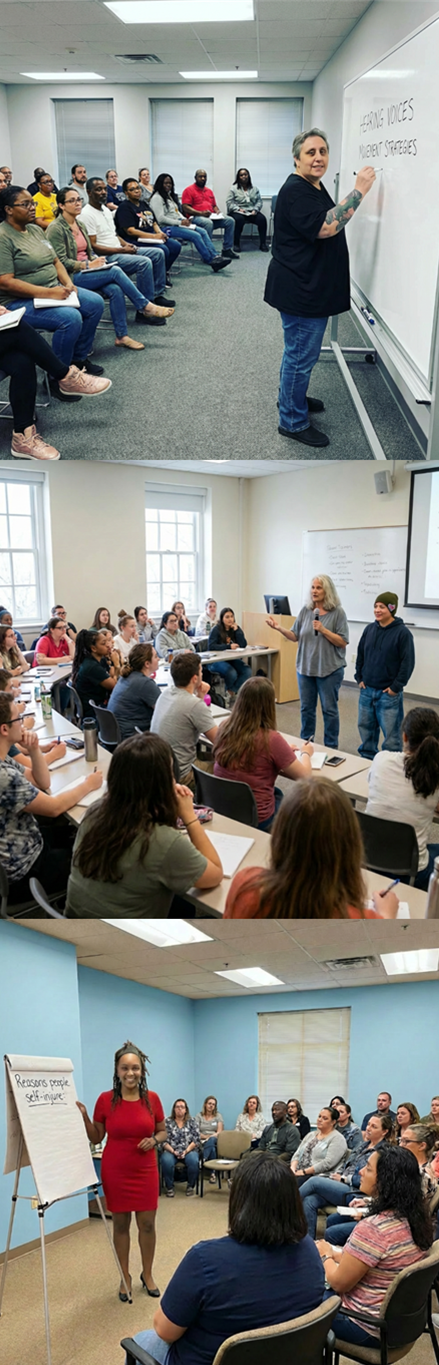
CLICK ON EACH TOPIC BELOW TO LEARN MORE!
Our Hearing Voices trainers have personal experience with hearing voices, seeing visions and/or related experiences, as well as supporting others who are navigating those experiences, too.
Our training team also includes one of the original co-founders of Hearing Voices USA (Sera Davidow), as well as one of the first group facilitators of the longest standing Hearing Voices group in the Northeast and a co-founder of the first ever on-line Hearing Voices Family & Friends groups in the world (Cindy Marty Hadge).
Some of the areas we cover include:
- Understanding the Hearing Voices Movement
- Evidence base for the Hearing Voices approach
- Facilitating Hearing Voices Groups
- Support strategies for clinical providers
- Maastricht Interview for hearing voices and/or unusual beliefs/paranoia
- Voice dialoguing & other navigation strategies
- Supporting family & friends
- Harm reduction approaches to voices, visions and unusual beliefs
- Navigating violent or scary voices
- Navigating voices that are suspicious of or blame the supporter
- Relationship to systemic oppression (racism, homophobia, transphobia, etc.)
- And more!
And view our page on Hearing Voices to learn about possibilities for train-the-trainer trainings!
Our trainers for this topic have personal experience with suicidal thoughts and/or attempts, as well as supporting others who are navigating those experiences, too.
Our training team also includes co-founders of the Alternatives to Suicide and SHARES on Suicide approaches.
Some of the areas we cover include:
- The SHARES on Suicide approach
- Facilitating SHARES groups
- Supporting family and friends
- Preparing supporters to be ready to support
- Young people and suicide
- Harm reduction approaches
- The relationship between suicide and self-injury
- What the research says about risk assessment & hospitalization
- Unpacking “safety planning” and other strategies
- Making meaning of suicidal thoughts
- Relationship to systemic oppression and marginalization
- And more!
Our trainers for this topic have personal experience with self-injury, as well as supporting others who are navigating those experiences, too.
Some of the areas we cover include:
- Why people self-injure
- Building awareness of different types of self-injury
- Harm reduction approaches
- The relationship between self-injury and suicide
- Relationship to systemic oppression and marginalization
- And more!
Our trainers for this topic have personal experience with various forms of systemic oppression, as well as supporting others who are navigating those experiences, too.
Some of the areas we cover include:
- Anti-oppression principles
- Building understanding of different forms of oppression (racism, homophobia, transphobia, etc.)
- Recognizing & navigating psychiatric oppression
- Common parts between different forms of oppression
- Understanding concepts (implicit bias, default design, microaggresions, etc.)
- Interruption strategies
- Impact vs. intent
- The art and importance of apology
- How to respond when someone accuses you of something you didn’t do
- History of psychiatry and systemic oppression
- And more!
Our trainers for this topic have personal experience with surviving trauma, as well as supporting others who are navigating those experiences, too.
Some of the areas we cover include:
- Trauma basics (understanding trauma responses, etc.)
- Understanding trauma-informed practices in all environments (e.g., doctor and dentist offices, etc.)
- Trauma-informed crisis responses
- Trauma-informed responses within families
- Childhood trauma
- Evaluating your program for fidelity to trauma-informed practices (STEPS approach, etc.)
- And more!
Our trainers for this topic have personal experience with problems with substance use, as well as supporting others who are navigating those experiences, too.
Some of the areas we cover include:
- The relationship between substance use and trauma
- Many pathways and definitions of recovery
- Integrating support related to substance use with mental health supports
- Navigating tensions between 12-step and other forms of peer support
- Strategies rooted in choice and self-direction
- And more!
Our trainers for this topic have personal experience working in peer support roles, as well as supporting others who are working in peer support roles, too.
Multiple trainers also have experience developing and facilitating state certification programs for peer specialists and similar.
Some of the areas we cover include:
- The basics of peer support (what it is and isn’t)
- Being an effective change agent
- Navigating tensions with providers and systems
- Navigating moral injury
- Signs peer roles are being misused
- Supporting providers to understand peer support roles
- Strategies for protecting peer roles from co-optation
- And more!
Our trainers for this topic have a variety of experiences including working as providers, receiving services from providers and – in some cases – both.
We strive to approach trainings in this category with the reality that both providers and people receiving services are deeply impacted by the way our systems operate and seek to build understanding and bridge gaps to reduce harm.
Some of the areas we cover include:
- Building critical provider support networks
- Grieving harm done
- Processing past grief so it doesn’t drive future practice
- Mandated reporter laws and other barriers to working differently
- Navigating power imbalances
- Navigating power struggles
- Provider boot camp (an intensive training designed to build understanding of the impacts of loss of power and the importance of sharing power and minimizing harm)
- And more!
Our trainers for this topic typically have personal experience as both family members and people who’ve struggled themselves, as well as supporting others who are navigating challenging situations as family and/or friends themselves.
Some of the areas we cover include:
- Overview of support strategies for family and friends
- The importance of getting your own support
- Navigating the needs of the whole family or friend group
- Family crisis responses and plans
- Facilitation of Hearing Voices groups for family and friends
- Facilitation of SHARES on Suicide groups for family and friends
- And more!
Our trainers for this topic have personal experience with navigating crisis, as well as supporting others who are navigating those experiences, too. Some of our trainers also have experience working directly with a variety of crisis alternatives (alternatives to policing programs, peer respites, etc.).
Some of the areas we cover include:
- Recognizing a true crisis (The 4 Ds approach, etc.)
- Strategies for navigating crisis situations
- Key considerations for alternative crisis response teams
- Navigating crisis for first responders
- Building sustainable crisis alternatives (crisis response teams, peer respites, etc.)
- And more!
Our trainers for this topic have personal experience with building, sustaining and staying in peer respites, as well as supporting others who are working in peer respites, too.
Our training team includes the author of the only comprehensive handbook on peer respites, the Peer Respite Handbook: A Guide to Understanding, Building and Supporting Peer Respites.
Some of the areas we cover include:
- Building a new peer respite
- Sustaining an existing peer respite
- Evaluating peer respite fidelity
- Navigating challenging situations (sexual harassment, suicide, self-injury, etc.)
- Navigating external pressures to conform
- And more!
Looking for something you don’t see here? Just ask! This isn’t a complete list of what we can offer and we’re open to working with you to meet your needs!
UPCOMING TRAININGS
Learn more about our specialty areas of training
Our Team
Cindy Marty Hadge
Cindy is an internationally recognized trainer with over a decade of experience and many years of life experience as a voice hearer and trauma survivor who has also navigated problems with substances and more.
Cindy specializes in topics like voice hearing, trauma, peer support, self-injury & family support.

Sera Davidow
Sera is an internationally recognized trainer with over two decades of experience and many years of life experience as a survivor of childhood trauma and domestic violence who has navigated suicidal thoughts and more.
Sera specializes in topics like suicide, self-injury, peer respite, policy development, grant writing and more.

Alexander Campanario Araica
Alex is a new trainer with extensive experience in trauma and domestic violence, disability and chronic illness, and more.
Alex specializes in topics like trauma, suicide, peer respite and anti-oppression topics related to gender, and Latine and Indigenous identities.

Ebony Flint
Ebony is a nationally recognized trainer with over a decade of experience and many years of life experience with trauma, parenting, disability, self-injury and more.
Ebony specializes in navigating anger, parenting, self-injury, anti-oppression topics related to racism and more.

Martha Barbone
Martha is a nationally recognized trainer with over a decade of experience and many years of life experience with trauma, as a veteran and more.
Martha specializes in development of peer roles, navigating ageing and loneliness, suicide, self-injury and more.
And introducing…
Peter Bullimore
Peter Bullimore and his team regularly joins us from England to offer trainings on voice hearing, unusual beliefs, the Maastricht Interview and more.