
What is SHARES?
SHARES is a new lived-experience informed*, harm reduction approach to suicide. It was co-created with one of the founders of the Alternatives to Suicide approach who is also now a co-founder of Roots Up, along with other members of Roots Up.
The approach is designed to be used by anyone (providers, peer supporters, family members, first responders and anyone else wanting to be a part of a better way to respond to people who are navigating suicidal thoughts). It can be used as a group approach, in 1:1 support and in any other setting. The concepts can also be generalized as a framework for providing support related to just about anything, not just suicide.
*”Lived experience-informed” means that this approach has been developed by people who themselves have been suicidal and experienced a variety of system supports in response to that experience.
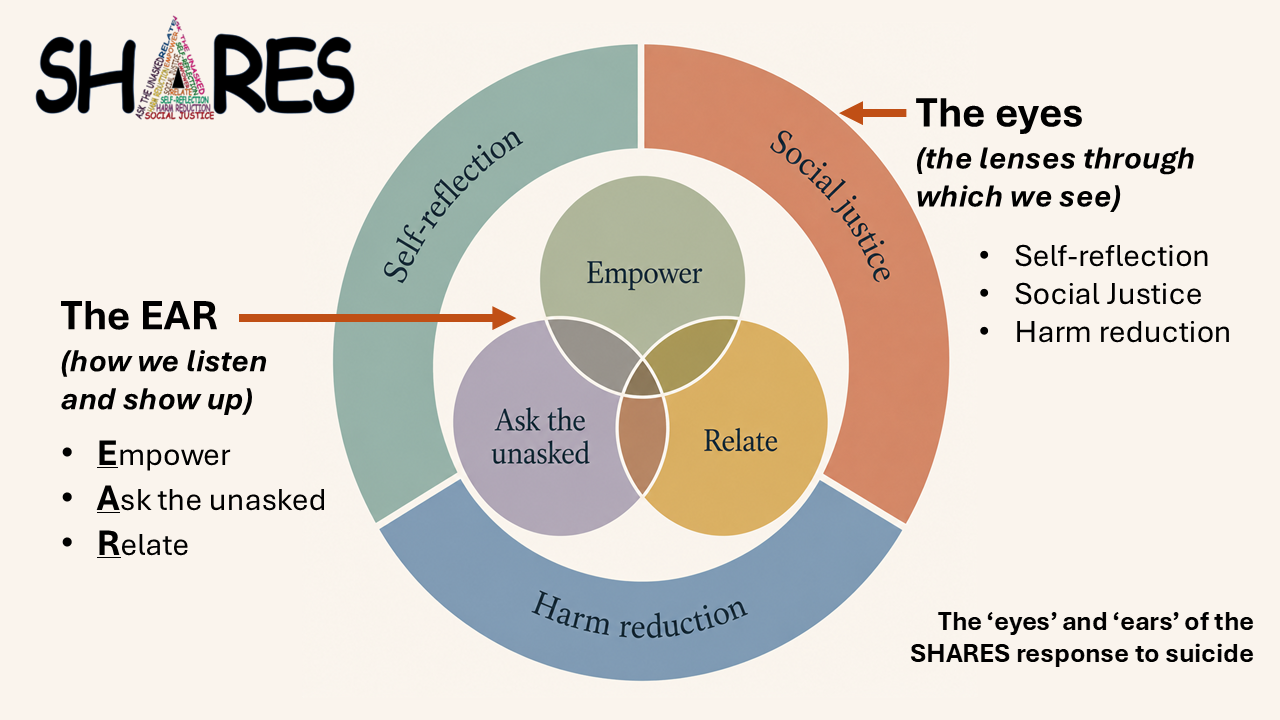
SHARES stands for:
- SELF-REFLECTION (instead of assessing others)
- HARM REDUCTION (instead of ‘hero’)
- ASK THE UNASKED (instead of the same old lines)
- RELATE (instead of othering)
- EMPOWER (instead of taking power)
- SOCIAL JUSTICE (instead of internal pathology)
SHARES Training & Consultation:
Types of trainings & consultation
We are available to offer a variety of talks, presentations and trainings on suicide and the SHARES on Suicide approach including, but not limited to:
- SHARES overview
- Putting the SHARES approach to practice
- Using the SHARES approach in groups
- Understanding the relationship between suicide and self-injury
- Navigating suicidal thoughts with young people
- Making meaning of suicidal thoughts
- The relationship between suicidal thoughts and systemic oppression
- Supporting the supporter
- And more!
We are also available for individual, family or organizational consultation with people interested in re-evaluating their approach to suicide, looking to create or update policies and similar.
Request training & consultation:
Although we strongly recommend in person trainings whenever possible, we know that cost and accessibility limitations can make that difficult. We are available to provide trainings in person or virtually to any person or group interested in learning how to better support people struggling with suicidal thoughts.
At times, we will have virtual trainings available. Any open training opportunities available through Roots Up will be listed on our ‘Current Trainings’ page.
If you are interested in scheduling a training or consultation specifically for your area or group, please fill out a request form and let us know what you’re looking for and we will get back to you shortly.
Overview of SHARES on Suicide
The evidence for SHARES:
Research Limitations:
Understandably, many people focus on “evidence-based practice”. Evidence and research are important. However, it’s also important to remember that the research base has been skewed by many of the same factors that impact all of our systems. This includes:
- It takes access to a lot of resources to make research happen. Often that means having money allotted for that purpose and/or university connections.
- At least historically, there have been clear racial skews in who gets their research published, as well as who is studied.
- Similarly, research biases Western Culture (with college students in Western societies being particularly over-represented as research subjects)
- People with lived experience of what’s being studied are historically and ongoingly severely underrepresented which influences which impacts every stage of what’s studied, including the questions asked and priorities presumed.
- More innovative approaches don’t necessarily lend themselves well to some of the approaches most familiar to the research community.
- Research of people with psychiatric histories has often caused substantial harm to those being researched, with many people now understandably unwilling to participate.
Drawing from research on conventional clinical approaches
Because very little time and resources have been put into studying approaches like SHARES, it can be important to also factor in what we know about the efficacy (or lack thereof) of other approaches. This can at least help establish the need for something different. For example:
- There is a significant body of evidence establishing that acute suicide risk assessments (“Are you suicidal”, “Do you have a plan?”, etc.) are not effective.
- Standard suicide risk assessment tools can actually cause harm by encouraging dishonesty from those in distress.
- Use of force in response to perceived suicide risk (e.g., forced evaluation/hospitalization) has been shown to increase suicide risk over the long-term.
- Use of force also reduces likelihood that someone will reach out for help in the future.
- Use of force is a loss of power which is experienced by many people as a trauma. The Adverse Childhood Experiences Study (ACES) are among those studies that tells us that traumas compound one another and increase risk of suicide over the long-term.
The evidence in favor of harm reduction approaches like SHARES
Although still developing, there is a growing body of evidence that tells us that harm reduction approaches to suicide work. For example:
- Willingness to set aside suicide risk assessment tools and conventional responses to perceived suicide risk opens up space to have real conversations about what’s going on which can be life changing for many people.
- Approaches that move away from seeing suicidal thoughts as ‘the problem to be stopped’ and make space for making meaning of those thoughts can also facilitate a process of people learning to see those thoughts as signs and help prevent people from feeling as if they need to act on them.
- Approaches that focus on power sharing can reduce suicide risk. This is in direct contract with conventional approaches that often increase suicide risk by taking power away in an effort to ‘keep someone safe’.