Workplace safety legislation does more than express concern for workers. Depending on how it is written, it can also change what happens to patients and others receiving services when an interaction goes badly.
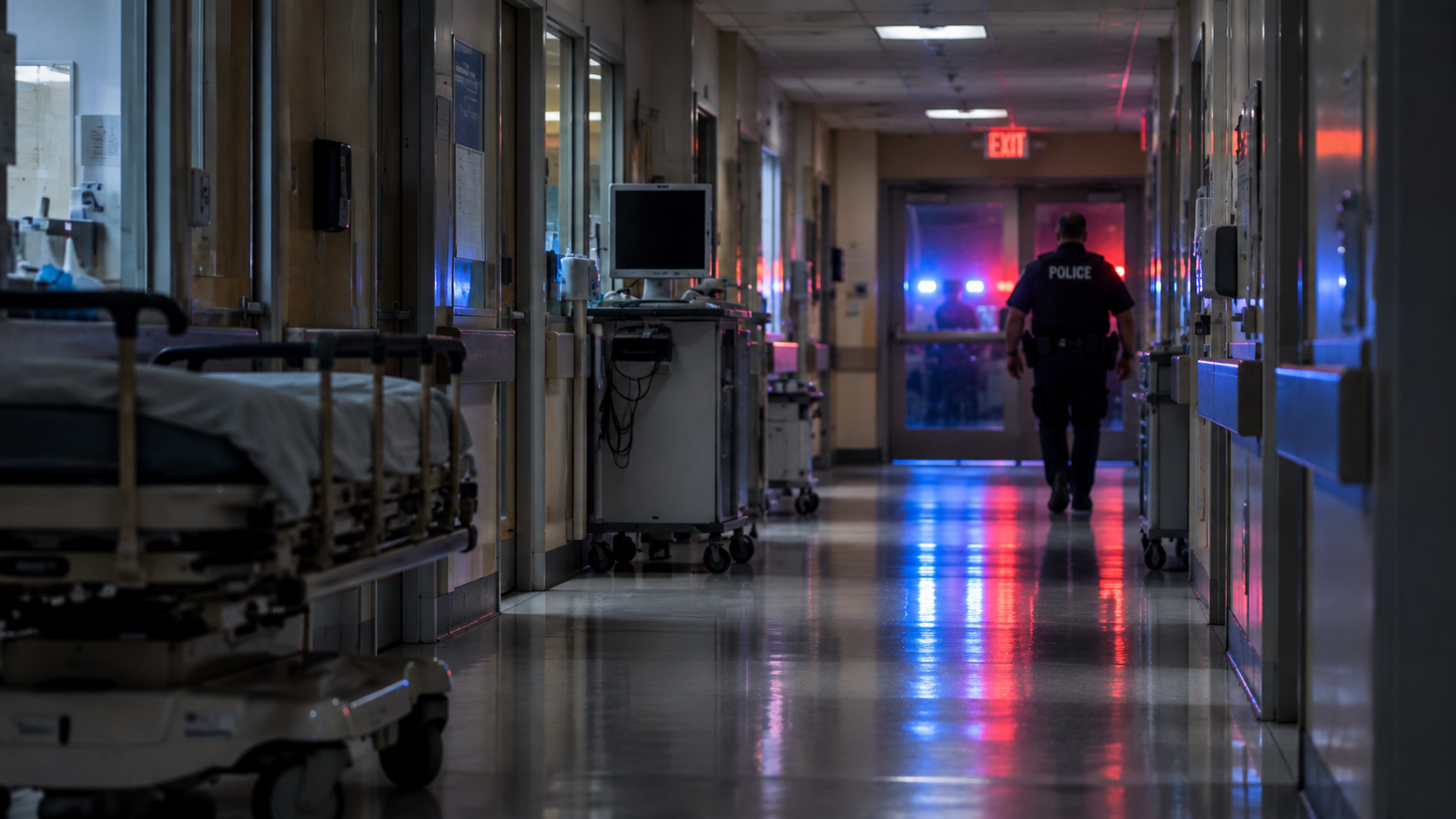
That is particularly important in the healthcare workplace violence legislation currently before Massachusetts lawmakers. The House and Senate versions differ significantly, but the Senate bill would expand circumstances in which police can make warrantless arrests following alleged assaults against healthcare workers.
The provision would initially apply in hospitals and, after one year, expand to other covered settings, including certain group homes.
Expanding police authority in healthcare and disability-service settings is not occurring on neutral ground. Race, disability, psychiatric diagnosis, immigration status, gender identity, and other forms of marginalization already affect people’s experiences with healthcare, coercive interventions, and law enforcement.
The question is not simply whether workplace violence is a serious problem. It is also who bears the risks created by the proposed solution.
Race, psychiatric intervention, and policing
Massachusetts does not have to speculate about whether racial disparities exist where psychiatric intervention and law enforcement intersect. We already have evidence that they do.
Simon and colleagues examined 488 applications for involuntary psychiatric hospitalization submitted by outside clinicians to the Boston Police Department. Black people represented 41% of the people named in those applications, despite comprising approximately 23% of Boston’s population. White people represented just 29% of the applications while comprising approximately 49% of the city’s population. The researchers described the racial disparities they found as substantial.
There was another troubling finding: 76% of those applications were submitted without the clinician first directly examining the person. Police were therefore frequently being asked to locate and involuntarily hospitalize someone based on an application from a clinician who had not personally examined them immediately beforehand.
Racial disparities continue once people reach the hospital.
A study examining more than 32,000 Massachusetts emergency-department encounters involving people held under Section 12 found that, after adjustment for other measured factors, Black patients had 22% higher odds of being physically restrained than white patients, while Hispanic patients had 45% higher odds. Having a bipolar or psychotic-disorder diagnosis was itself associated with greater odds of restraint.
Research at Boston Medical Center found another intersection between race and mental health. Among women with mental-health or substance-use diagnoses, Black women had nearly twice the odds of restraint as white women, while women categorized by the researchers as Hispanic had more than twice the odds. Black men with mental-health or substance-use diagnoses also experienced higher odds of restraint than white men.
And police involvement may itself be part of the pathway toward coercion.
A large 2024 study involving more than four million emergency-department visits across 13 hospitals found that Black patients had 33% greater adjusted odds of restraint than white patients. Black patients were also more likely to arrive through police transport, and patients brought to the emergency department by police had more than five times the adjusted odds of restraint compared with people arriving through other means. Researchers estimated that police transport explained a portion of the Black-white disparity in restraint.
This establishes something that should matter enormously to legislators: new police authority would be introduced into systems where significant racial disparities already exist.
When disability-related behavior becomes a police matter
The risks become particularly apparent when the definition of a healthcare facility extends beyond what many people picture when they hear that phrase.
The Senate provision would ultimately reach certain residential programs operated, funded, or overseen by state agencies.
People with intellectual and developmental disabilities or autism may communicate fear, pain, sensory overload, frustration, or distress through actions. Someone overwhelmed by unwanted touch may push a person away. Someone who has difficulty communicating what is happening may lash out. An autistic person experiencing sensory overload may respond to commands, physical proximity, or attempts at restraint in ways that many people don’t understand.
These actions can certainly result in injury. Recognizing disability does not require pretending otherwise.
But an injury does not tell us whether arrest is the safest or most appropriate response.
A 2026 analysis of approximately 3.3 million police stops in California found that identification as having an intellectual or developmental disability was associated with an approximately 6.5-percentage-point increase in the probability of being handcuffed and a 7.5-point increase in the probability of being detained, after statistical adjustment.
Research involving police encounters with autistic people also demonstrates how frequently law enforcement enters situations that did not begin as crimes. Reported reasons for police involvement have included disruptive behavior, leaving a supervised setting, suspected abuse or neglect, and other noncriminal behavior, with responses ranging from supportive intervention to highly controlling actions.
The Massachusetts Senate appears to recognize some of these dangers itself.
Its legislation calls for recommendations for people involved with the criminal legal system who have mental or behavioral health diagnoses or intellectual and developmental disabilities. Those recommendations are specifically supposed to consider pathways to services that do not require arrest and ways to minimize reliance on law-enforcement intervention in group homes. Read this provision in the Senate amendment
That creates a striking tension within the legislation.
If Massachusetts recognizes the need to minimize police intervention in group homes and develop alternatives that do not require arrest, why simultaneously expand warrantless-arrest authority into those same homes?
Emotional distress can become criminalized
Similar concerns arise for people experiencing emotional or mental distress.
Fear, confusion, dissociation, trauma responses, extreme emotional states, and difficulty processing what is happening can all affect how someone responds to demands, authority, physical proximity, or unwanted touch.
Increasing police involvement can itself change an encounter.
The Massachusetts research on Section 12s, which allow involuntary hospitalization for psychiatric evaluation, and restraint is especially important here because race and psychiatric disability do not exist in separate boxes. A Black person experiencing psychiatric distress encounters systems carrying both histories at once.
Nor is coercion rare within psychiatric settings. One Massachusetts analysis documented more than 92,000 episodes of restraint and seclusion in inpatient psychiatric facilities between 2008 and 2018.
Against that background, expanding arrest authority inside healthcare environments deserves more than a general discussion about whether healthcare workers experience violence.
It requires asking what happens when behavior arising during psychiatric crisis moves from being understood as a clinical or support issue to becoming a criminal one.
Trans people enter these systems during an extraordinary period of vulnerability
For transgender people, expanded police authority in healthcare settings would arrive at a particularly difficult moment in time.
Access to gender-affirming healthcare is currently the subject of intense federal action and litigation, including actions directly affecting patients and providers in Massachusetts. At the same time, Massachusetts has taken steps to protect access to gender-affirming care. In September 2026, Massachusetts joined a multistate lawsuit challenging a new federal rule restricting Medicaid and CHIP reimbursement for specified gender-affirming care for minors and some young adults. Massachusetts Attorney General’s September 2026 announcement
Trust in healthcare institutions matters enormously in that environment.
Yet the 2022 U.S. Transgender Survey found that 24% had avoided needed medical care because they feared mistreatment. Among respondents who had seen a healthcare provider during the preceding year, 48% reported at least one negative experience because they were transgender, including refusal of care, misgendering, harsh or abusive language, or physically rough treatment.
Those concerns extend specifically into emergency and psychiatric care.
A 2023 review of research on transgender and gender-diverse people in emergency psychiatric settings found evidence of service denial, discrimination, and other inequities. It also revealed how little research has actually examined the experiences of trans people within psychiatric emergency settings.
That absence of research matters.
We do not currently have evidence establishing that transgender people are more likely to be arrested, restrained, secluded, or involuntarily hospitalized under circumstances like those contemplated by this legislation. That should not be turned into a claim that they are.
But neither should the absence of data be mistaken for evidence that no disparity exists.
What we do know is that transgender people report substantial mistreatment within healthcare, including emergency and mental-health settings; some already avoid necessary care because they fear mistreatment; and many report profound distrust of law enforcement.
In the U.S. Transgender Survey’s data on interactions with law enforcement, 73% of respondents said they would be somewhat or very uncomfortable asking police for help, and 62% said they were uncomfortable asking police for help because of their gender identity or expression.
That creates a combination legislators should examine carefully: a population that already has reason to distrust healthcare, already has reason to distrust police, and sometimes encounters both systems simultaneously during moments of acute distress.
At a time when transgender people’s access to healthcare is under extraordinary political pressure, Massachusetts should be asking whether additional police authority inside healthcare settings could further undermine trust or discourage people from seeking care.
Immigration status adds another layer of fear
For immigrant communities, a somewhat different concern arises.
Massachusetts has explicitly recognized concerns surrounding immigration enforcement and access to healthcare. State officials have issued guidance for immigrant patients and healthcare providers regarding immigration enforcement, and state policy has sought to protect access to healthcare and clarify patients’ rights.
The arrest authority contemplated in the workplace violence legislation concerns ordinary criminal law, not civil immigration enforcement. They are different legal systems, and it would be misleading to conflate them.
But patients do not necessarily experience government systems as neatly separated categories.
For someone already frightened that contact with authorities could threaten their family, immigration status, or safety, increasing visible law-enforcement involvement within healthcare may carry consequences beyond the immediate encounter.
At minimum, that possibility deserves examination rather than assumption.
Marginalization does not happen one category at a time
There is another problem with discussing these risks group by group.
People do not experience systems one identity at a time.
A Black autistic person does not encounter police first as Black and then, separately, as autistic. A transgender person experiencing psychiatric distress does not leave their gender identity outside the emergency department. An immigrant with a psychiatric diagnosis may be navigating language access, fear of government systems, disability, and racialization simultaneously.
The existing research already provides glimpses of these intersections. That is precisely why simply creating a neutral-sounding arrest power and assuming it will affect everyone equally is inadequate.
What will Massachusetts actually measure?
Perhaps the most striking problem is how little the legislation requires Massachusetts to learn after expanding this authority.
The Senate does contain important provisions concerning prevention, risk assessment, and recommendations for people with behavioral-health diagnoses and intellectual or developmental disabilities. But it does not establish the kind of systematic evaluation necessary to determine whether expanded criminal enforcement actually reduces workplace violence or whether it creates disparate harms.
If Massachusetts creates new arrest authority in healthcare and disability-service settings, the Commonwealth should know who experiences it.
How many arrests occur?
Where do they occur?
What precipitated them?
How many involve people receiving psychiatric or disability services?
How many occur in group homes?
What are the racial and ethnic demographics of those arrested?
Are people with psychiatric disabilities, intellectual or developmental disabilities, or autism disproportionately represented?
Are transgender people disproportionately affected?
What happens after arrest? Are people charged? Prosecuted? Convicted? Diverted? Are charges ultimately dismissed?
And, critically, does any of it actually make healthcare workers safer?
Those questions should not require advocates to reconstruct the answers years later from scattered police records, court data, hospital reports, and public-records requests.
They should be part of the law.
Comments are closed